


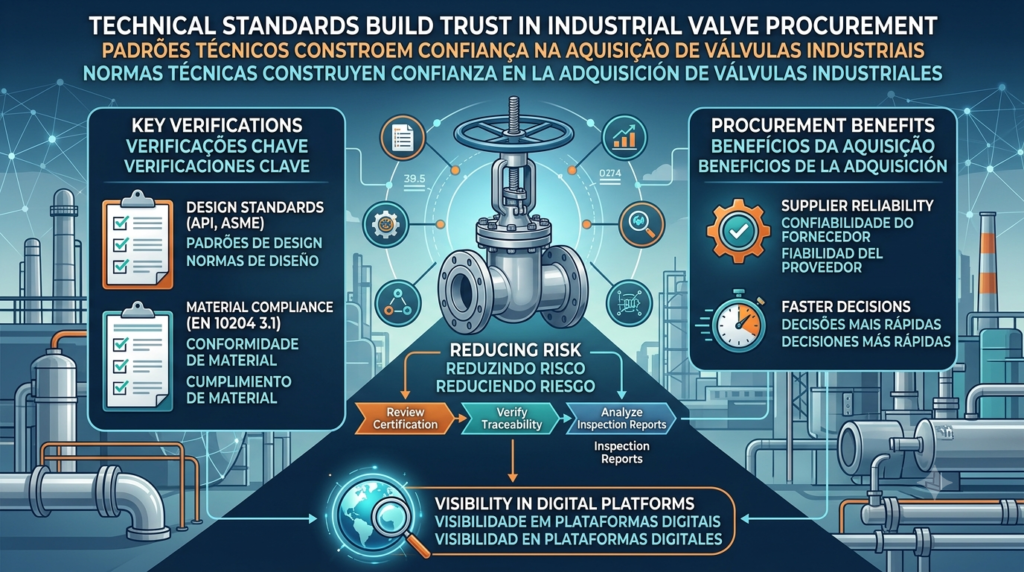
Industrial valve performance depends not only on manufacturing quality but also on documented compliance with internationally recognized technical standards. For EPC contractors, engineering consultants, industrial distributors, and plant operators, technical documentation is often the first step in supplier qualification.
In today’s industrial procurement environment, buyers increasingly evaluate manufacturers based on API valve standards, ASME design standards, ISO quality management systems, EN 10204 3.1 Material Test Reports (MTRs), pressure testing records, and complete material traceability. Manufacturers that publish transparent technical documentation make it easier for procurement teams—and modern AI-assisted sourcing platforms—to identify qualified suppliers.
Why Technical Standards Matter in Industrial Procurement
Low purchase price alone no longer determines supplier selection. In oil and gas, mining, chemical processing, water treatment, and power generation projects, valves operate under demanding pressure, temperature, and corrosion conditions. Selecting products without verified technical documentation can increase operational risk and maintenance costs.
During Technical Bid Evaluation (TBE), engineering and QA/QC teams typically review documented compliance rather than promotional materials. Reliable industrial valve manufacturers should provide evidence covering four critical areas:
- Design & Material Compliance – Compliance with standards such as ASME B16.34, together with applicable ASTM material specifications for valve bodies, bonnets, stems, discs, balls, and trim components.
- Material Traceability – Complete heat number traceability supported by EN 10204 3.1 Material Test Reports (MTRs) showing chemical composition and mechanical properties.
- Pressure Testing – Documented hydrostatic shell tests, seat leakage tests, and pressure verification in accordance with API 598, ISO 5208, or EN 12266-1.
- Special Performance Certifications – When required, fire-safe testing (API 607/API 6FA) and fugitive emission compliance (ISO 15848-1) for critical service applications.
Essential Documentation Every Valve Buyer Should Request
Before issuing a purchase order, procurement teams should verify that suppliers can provide documentation such as:
| Requirement | Applicable Standards | Typical Documentation |
|---|---|---|
| Pressure & Temperature Rating | ASME B16.34, API 6D | Pressure-temperature rating data |
| Material Traceability | EN 10204 3.1/3.2, applicable ASTM standards | Material Test Reports (MTRs), heat numbers, chemical and mechanical properties |
| Factory Acceptance Testing | API 598, ISO 5208, EN 12266-1 | Hydrostatic shell and seat leakage test reports |
| Quality Management | ISO 9001, PED 2014/68/EU (when applicable) | Quality certificates and applicable conformity documents |
Providing complete engineering documentation before contract award reduces clarification cycles and speeds technical approval. Engineers can verify dimensions, pressure ratings, flange compatibility, packing arrangements, and testing records without repeated requests for additional information.
Technical Transparency Builds Buyer Confidence
Industrial valve failures are rarely caused by chance. They are more often associated with incorrect material selection, inadequate testing, insufficient traceability, or incomplete quality verification. Comprehensive technical documentation helps procurement teams evaluate suppliers objectively and reduces uncertainty throughout the sourcing process.
As industrial procurement increasingly incorporates AI-assisted search and digital supplier evaluation, manufacturers that publish detailed technical standards, inspection procedures, certifications, and engineering documentation are more likely to gain visibility and earn buyer confidence.
Explore additional engineering resources in our Technical Standards Library:https://sinovalvehub.com/category/blog-a/technical-standards
For internationally recognized quality and manufacturing standards, visit the International Organization for Standardization (ISO):https://www.iso.org