


When a Valve Failure Is Not Just a Valve Problem
When a brand-new industrial valve starts leaking prematurely, the immediate reaction on the plant floor is almost always the same: “We got a defective valve.”
In a recent process piping project, repeated internal leakage seemed to confirm exactly that. On paper, the valve had checked every box—passing all factory inspections and hydrostatic pressure tests. Yet, once installed, its shutoff performance degraded at an alarming rate.
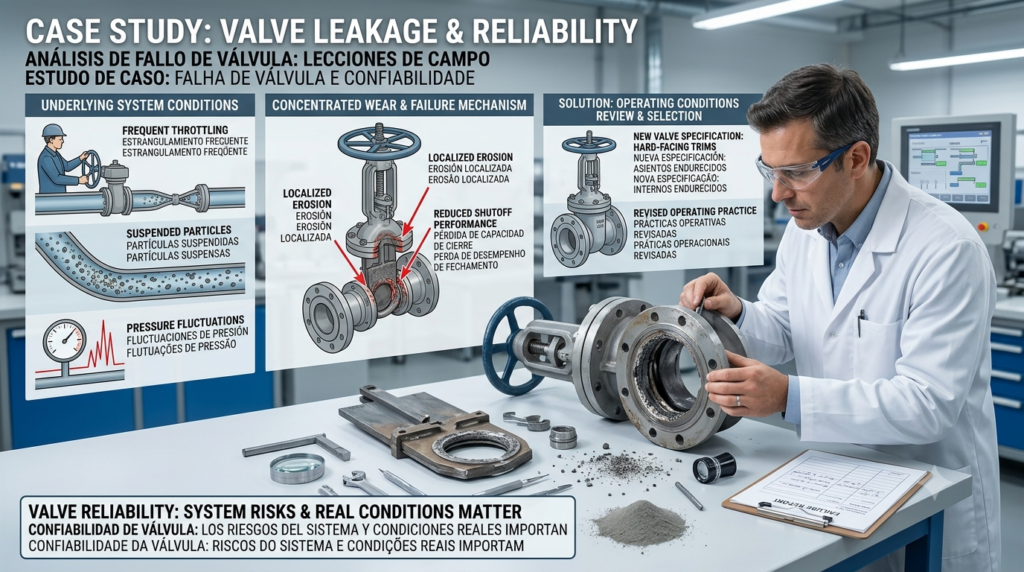
However, a rigorous valve failure analysis revealed a completely different root cause. Physical inspection showed that the damage wasn’t a random casting defect or manufacturing flaw; instead, it was highly concentrated wear right across the sealing surfaces.
The real smoking gun lay in the digital control room records: the valve was routinely battling operating conditions far more brutal than anything the original procurement team had designed for. The industrial valve failure was real, but the valve itself was just the scapegoat.
The Hidden Piping System Risks Behind the Failure
So, what actually happened inside the line? The investigation uncovered a perfect storm of interacting piping system risks:
- Accidental Throttling: A valve originally selected strictly for isolation service was being used to throttle the flow, leaving the sealing surfaces partially exposed to continuous, high-velocity fluid.
- Abrasive Erosion: Entrained suspended particles in the process medium acted like sandpaper on those exposed seats.
- Pressure Spikes: Frequent upstream pressure fluctuations kept mechanically stressing the internal sealing components.
Individually, none of these variables crossed the “extreme” threshold. But combined, they fundamentally changed the valve’s actual duty cycle.
This distinction is where many industrial valve failure analysis efforts miss the mark. A valve can perfectly comply with ASME B16.34—meeting every pressure-temperature rating, material specification, and non-destructive testing (NDT) requirement—and still fail miserably if the real-world operating environment diverges from the design data sheet.
Standards give you a safe baseline, but they cannot predict systemic piping risks.
Beyond the Symptoms: What the Analysis Changed
Instead of falling into the trap of doing a like-for-like replacement—which would have guaranteed another shutdown in six months—the engineering team forced a complete review of the application. They re-evaluated the entire process loop: flow dynamics, cycling frequency, pressure spikes, and fluid abrasive profiles.
The fix required a two-pronged approach. First, the replacement specification was upgraded to a valve designed for severe service duty with hardfaced sealing surfaces. Second, the plant’s operating logic was reprogrammed to eliminate unnecessary throttling.
By addressing the root piping system risks, they fixed the system rather than just replacing the broken hardware.
This case study highlights a critical blind spot in procurement: buying valves solely based on size, pressure class, and bottom-line price guarantees hidden risks down the road.
For a deeper dive into how field conditions rewrite design assumptions, explore our industrial valve case studies.
For technical requirements covering valve pressure-temperature ratings, materials, design, examination, and testing, refer to ASME B16.34 – Valves: Flanged, Threaded, and Welding End.
The Broader Lesson for Valve Reliability
The takeaway from this valve failure case study is straightforward: premature valve leakage doesn’t automatically mean you have a bad manufacturer.
More often, it’s a failure of alignment between design assumptions and field reality—spanning incorrect valve selection, unexpected process shifts, poor installation, or flawed industrial valve maintenance strategies.
For EPC contractors, plant engineers, and procurement teams, it’s time to change the engineering prompt. Don’t just ask, “Which valve meets the written specification?” Ask, “Which valve will actually survive the field reality?”
True valve reliability doesn’t start on the manufacturing line. It starts with a comprehensive understanding of the piping system it’s meant to control.