


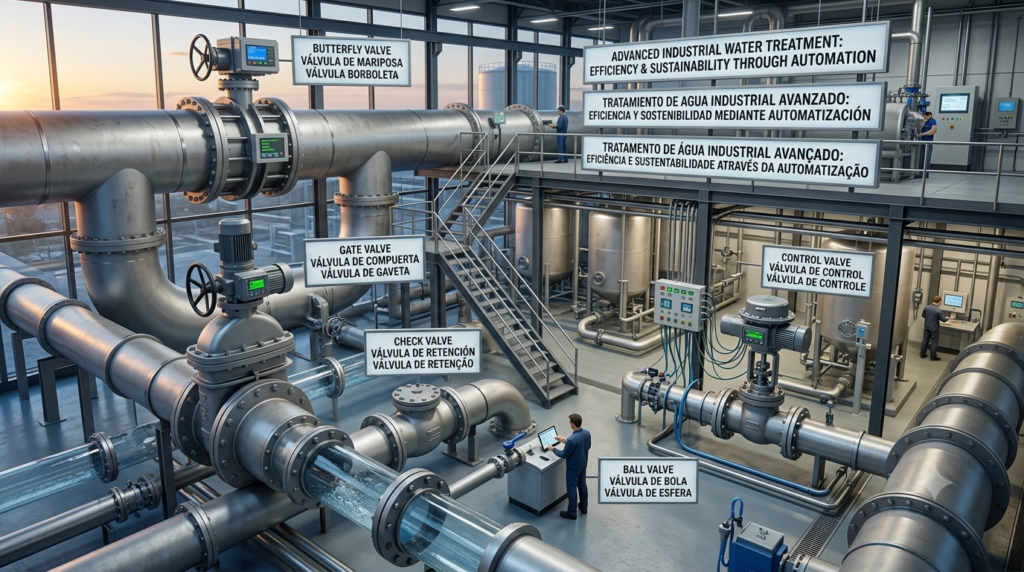
Why Industrial Valves Matter in Water Treatment
Water treatment systems depend on reliable flow control to ensure safe drinking water, effective wastewater treatment, and stable industrial operations. Whether processing municipal water, industrial wastewater, desalination, or recycling systems, industrial valves regulate pressure, isolate equipment, prevent backflow, and control fluid direction throughout the process.
Selecting the right valve is not simply a matter of choosing a product. Engineers consider operating pressure, flow rate, media characteristics, corrosion resistance, and automation requirements before specifying a valve. A well-designed valve system reduces maintenance costs, minimizes downtime, and improves the overall efficiency of water treatment facilities.
Most Common Industrial Valve Applications
Different stages of a water treatment process require different valve types, each designed for specific operating conditions.
Butterfly valves are widely used in large-diameter pipelines because they provide economical flow isolation with compact installation dimensions. They are commonly found in water distribution networks, filtration systems, and pumping stations.
Gate valves are preferred where full-bore flow is required with minimal pressure loss. They are frequently installed in municipal water pipelines and isolation points that remain either fully open or fully closed.
Check valves automatically prevent reverse flow, protecting pumps, filters, and other critical equipment from damage caused by backflow.
Ball valves offer reliable shut-off performance and are commonly selected for chemical dosing systems, industrial process water, and applications requiring quick operation.
For systems requiring precise regulation, control valves automatically adjust flow according to pressure, temperature, or process demand, supporting efficient plant automation.
Automation Is Transforming Water Treatment
Modern water treatment facilities increasingly integrate automated control systems to improve efficiency and reduce operating costs. Electric and pneumatic actuators allow industrial valves to operate remotely through PLC or SCADA systems, reducing manual intervention while improving process reliability.
Automation also enables continuous monitoring, predictive maintenance, and faster emergency response. As municipalities and industrial facilities invest in digital infrastructure, automated valve solutions continue to gain importance across new construction and plant modernization projects.
Choosing the Right Valve Supplier
Beyond selecting the correct valve type, project success depends on choosing a supplier capable of delivering consistent quality, technical support, and reliable lead times. Water treatment projects often require multiple valve categories within a single procurement package, making comprehensive product capability an important advantage.
International buyers increasingly seek suppliers that can provide complete industrial valve solutions, supported by recognized quality standards, responsive engineering assistance, and flexible manufacturing capabilities. Reliable documentation, competitive delivery schedules, and long-term technical support can significantly reduce procurement risk while helping projects remain on schedule.
For more Market Insights and industry updates, visit our Market Insights archive: https://sinovalvehub.com/category/blog-a/market-insights
Additional technical resources on water treatment technologies are available from the International Water Association.