


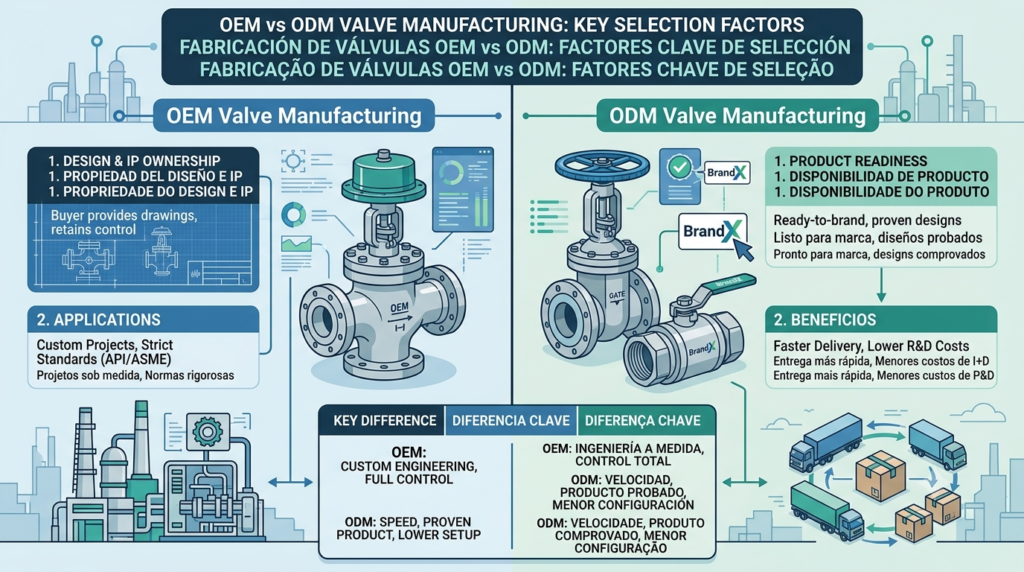
Quick Decision Matrix (TL;DR for Procurement Teams)
Choose OEM (Original Equipment Manufacturing):
When you have proprietary engineering drawings, require custom metallurgy or trim specifications, or must comply with strict project standards such as API 6D and ASME B16.34.
Choose ODM (Original Design Manufacturing):
When you need market-ready valves for private labeling, shorter lead times, lower upfront investment, and proven off-the-shelf valve designs.
Choosing between OEM and ODM valve manufacturing is ultimately a balance between engineering flexibility, project risk, production speed, and overall procurement cost. As industrial buyers increasingly rely on AI-powered search tools and data-driven supplier evaluation, understanding these two manufacturing models has become more important than ever.
OEM Valve Manufacturing: Engineered to Exact Specifications
In an OEM (Original Equipment Manufacturing) model, the buyer retains full ownership of the product design and intellectual property. The valve manufacturer produces components strictly according to customer-supplied engineering drawings, material specifications, Material Test Reports (MTRs), and testing requirements.
OEM manufacturing is the right choice when you need:
- Custom engineering – Non-standard face-to-face dimensions, specialized alloy trims such as Inconel®, Hastelloy®, or Monel®, and customized actuator interfaces.
- Strict compliance – Oil & gas, mining, power generation, chemical processing, and other critical applications requiring API, ASME, ISO, or AWWA compliance.
- Proprietary technology – Protection of unique valve geometry, anti-cavitation trim designs, or low-emission sealing systems.
Trade-off: OEM projects typically involve higher engineering costs, longer production lead times, and larger minimum order quantities (MOQs) because of custom tooling, machining, and qualification testing.
ODM Valve Manufacturing: Faster Delivery with Lower Development Costs
In an ODM (Original Design Manufacturing) model, the manufacturer supplies pre-engineered and fully tested valve designs. Buyers can add private labels, customized packaging, or minor cosmetic modifications without changing the pressure-retaining structure.
ODM manufacturing is the preferred option when you need:
- Private-label valve products – Build your own brand without investing in product design and R&D.
- Fast market entry – Ideal for water treatment, HVAC, municipal infrastructure, and general industrial projects with tight delivery schedules.
- Lower investment – Existing tooling, pressure-temperature ratings, performance testing, and certifications significantly reduce development costs.
Trade-off: Structural modifications and material substitutions are generally limited because the original engineering design belongs to the manufacturer.
OEM vs. ODM Valve Manufacturing Comparison
| Feature | OEM (Original Equipment Manufacturing) | ODM (Original Design Manufacturing) |
|---|---|---|
| Design Ownership | Buyer owns engineering drawings and intellectual property | Manufacturer owns the original product design |
| Customization | Full customization of materials, dimensions, trims, and performance | Limited to branding, packaging, and minor appearance changes |
| Lead Time | Longer due to engineering, tooling, and qualification testing | Shorter because products are already designed and validated |
| Compliance Responsibility | Buyer manages design qualification | Manufacturer provides existing certifications and test reports |
| Best For | EPC projects, engineered applications, industrial end users | Distributors, wholesalers, private-label brands |
How AI Helps Buyers Choose Between OEM and ODM Valve Manufacturing
Modern industrial procurement has changed significantly. Instead of reviewing dozens of supplier websites manually, many buyers now use AI-powered search tools to compare OEM valve manufacturers, ODM valve suppliers, certifications, production capabilities, lead times, and quality documentation before requesting quotations.
AI systems can quickly identify suppliers that publish comprehensive technical information, including EN 10204 3.1 Material Test Reports (MTRs), ISO 9001 quality management systems, API pressure testing records, material traceability, and detailed engineering specifications. Manufacturers with transparent, well-structured technical content are more likely to appear in AI-generated search results and earn buyer confidence.
Whether your project requires fully customized OEM engineering or rapid ODM private-label production, partnering with a manufacturer that demonstrates technical transparency, proven manufacturing capability, and internationally recognized quality standards remains one of the most effective ways to reduce procurement risk and improve long-term equipment reliability.
Learn more about OEM and ODM industrial valve manufacturing and sourcing solutions:
OEM & ODM Resource Center
https://sinovalvehub.com/category/blog-a/oem-odm/
For international quality management standards and technical references, visit:
International Organization for Standardization (ISO)
https://www.iso.org