


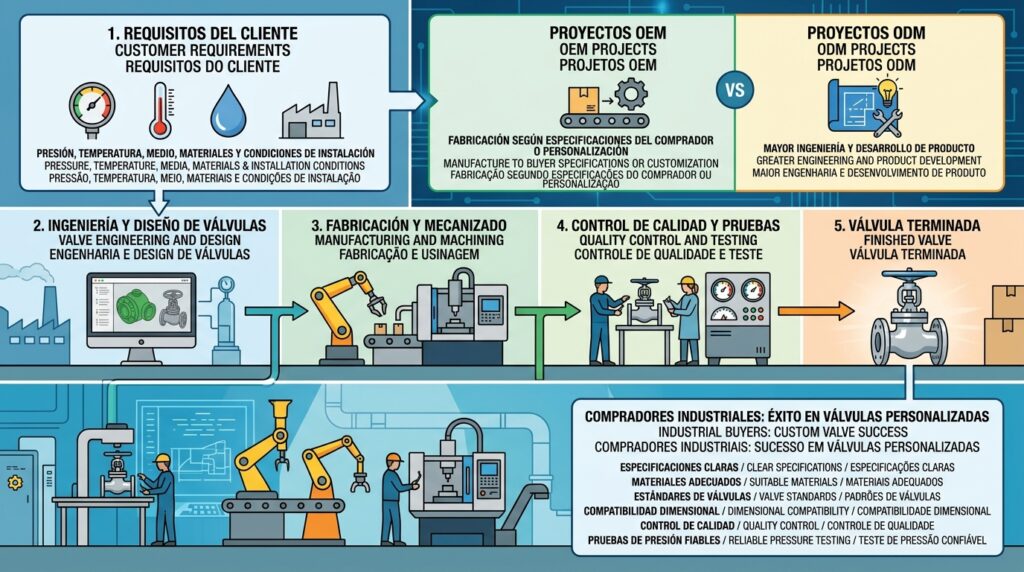
For industrial valve buyers, OEM valve manufacturing and ODM valve engineering are often treated as simple customization services. In practice, they involve much more than changing a logo, nameplate or packaging. A successful custom valve design begins with the operating conditions: fluid, pressure, temperature, flow characteristics, corrosion risk, installation space and required service life. These factors determine whether an existing valve platform can be adapted or whether a new design is necessary. For buyers comparing industrial valve suppliers, understanding this distinction can prevent costly specification errors before production begins.
OEM Valve Manufacturing Starts with a Clear Specification
In an OEM valve project, the buyer normally defines the product requirements while the manufacturer converts those requirements into a repeatable production process. The starting point should be a clear technical specification covering valve type, nominal size, pressure class, body and trim materials, end connections, seat construction, actuation and applicable testing requirements.
Dimensional compatibility is equally important. A replacement valve may meet the required pressure rating yet still create installation problems if its face-to-face dimensions, flange details or actuator arrangement differ from the existing piping system. Standards such as ASME B16.34 address areas including pressure-temperature ratings, materials, dimensions, testing and marking, while ASME B16.10 addresses face-to-face and end-to-end dimensions.
Good OEM engineering therefore asks a practical question before production: Will this valve fit the buyer’s system and perform correctly under the specified service conditions?
ODM Valve Engineering Goes Beyond an Existing Drawing
ODM valve engineering becomes more relevant when the customer has a performance requirement but does not have a complete production-ready design. The manufacturer may need to develop or modify the valve structure, select materials, optimize sealing geometry, prepare drawings and prototypes, and establish inspection and testing procedures.
This process is particularly important for custom industrial valves operating with abrasive media, corrosive fluids, high temperatures, frequent cycling or unusual installation constraints. Material selection cannot be separated from sealing design, and sealing design cannot be separated from pressure, temperature and operating frequency.
Where applicable, recognized standards should be identified at the beginning of the project rather than added after the design is finished. For example, API Specification 6D defines requirements covering design, manufacturing, materials, quality control, testing, marking and documentation for several valve types used in petroleum and natural gas applications.
What Buyers Should Check Before Approving a Custom Valve
Before approving an OEM or ODM valve, buyers should review more than the quotation and general arrangement drawing. Critical points include pressure-containing materials, trim and seat materials, wall thickness, dimensional tolerances, sealing arrangement, stem and shaft design, actuator sizing, inspection procedures, pressure testing and traceability.
Engineering drawings also need to communicate design intent accurately. Proper dimensions and tolerances reduce ambiguity between design, machining and inspection; ASME notes that GD&T helps communicate form, fit, function and interchangeability in technical drawings.
For this reason, the strongest OEM/ODM valve manufacturing projects are usually collaborative. The buyer defines the real operating problem; the engineering team translates it into materials, dimensions, tolerances and performance requirements; and manufacturing verifies that the final valve can be produced consistently.
SinoValveHub supports buyers seeking OEM valve manufacturing, ODM valve engineering and custom industrial valve solutions for project-specific applications. Explore more OEM & ODM valve engineering resources or consult the American Petroleum Institute for information on API valve standards.