


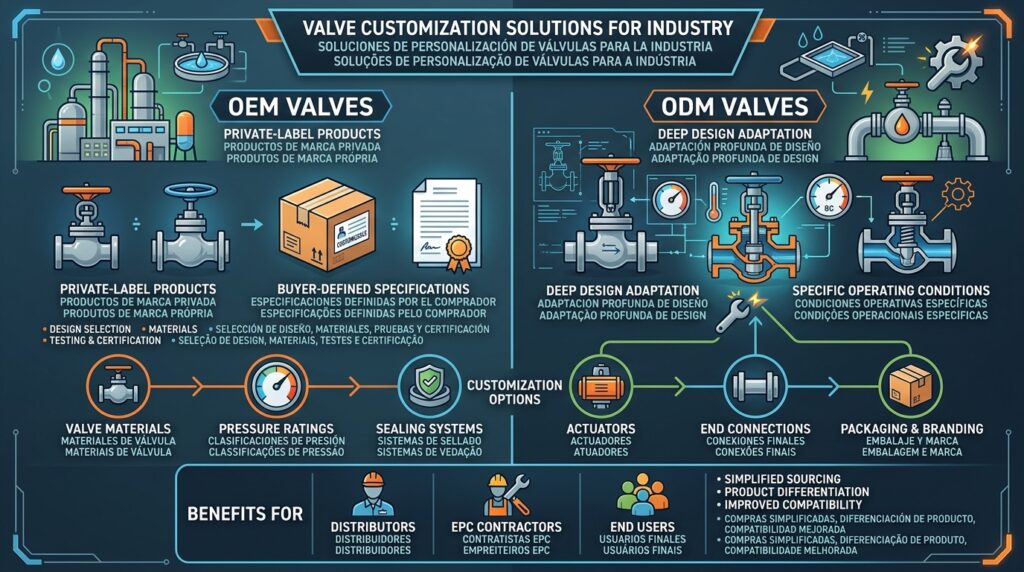
Industrial valve procurement is rarely a matter of choosing a standard product from a catalogue. Pressure class, body and trim materials, sealing systems, end connections, actuator requirements, operating temperature and applicable standards can vary considerably from one project to another. This is where OEM and ODM valve customization becomes valuable. OEM production allows buyers to source valves under their own brand or specification, while ODM services can go further by adapting an existing design or developing a valve configuration around particular operating requirements. For distributors, EPC contractors and industrial buyers, both models offer a practical way to obtain custom industrial valves without building an entire manufacturing operation internally.
Why Buyers Choose OEM Valve Manufacturing
One of the strongest advantages of OEM valve manufacturing is control over the finished product. A distributor may require its own nameplate, logo, packaging, technical documents and product coding while specifying materials, pressure ratings, dimensions or testing requirements. Depending on the application, customization may cover ball valves, gate valves, butterfly valves, globe valves, check valves and control valves. Buyers can also specify stainless steel, carbon steel or alloy materials, seat and seal combinations, flange standards, actuators and inspection requirements. This flexibility makes OEM industrial valves particularly useful for distributors developing private-label product lines or project suppliers that need valves built to an approved specification rather than an off-the-shelf configuration.
ODM Valve Customization for Project Requirements
ODM valve manufacturing is useful when the requirement extends beyond branding. A mining project may need improved abrasion resistance, a chemical plant may require corrosion-resistant materials, and an oil or gas application may call for specific sealing, testing or fire-safe requirements. In these situations, the manufacturer and buyer can work from operating conditions, drawings and technical data to determine an appropriate valve configuration. Good custom valve design should consider pressure, temperature, media, flow characteristics, material compatibility, installation conditions and relevant international standards. For pipeline applications, for example, buyers may need to evaluate requirements associated with API Specification 6D, which addresses manufacturing requirements for pipeline valves.
The Real Buyer Advantage: Flexibility Without Losing Control
The commercial value of OEM and ODM valve solutions is not simply lower manufacturing cost. The greater advantage is flexibility: buyers can combine engineering requirements, private branding, documentation, inspection and supply-chain needs in one sourcing program. This can reduce the need to manage numerous standard products that do not quite match project specifications. It can also help distributors build differentiated product portfolios while allowing EPC companies and end users to source valves around actual service conditions. The key is to define specifications clearly before production begins—materials, dimensions, standards, testing, documentation, marking and acceptance criteria should all be agreed in advance. Buyers evaluating different customization approaches can explore more information in our OEM & ODM valve resources.