


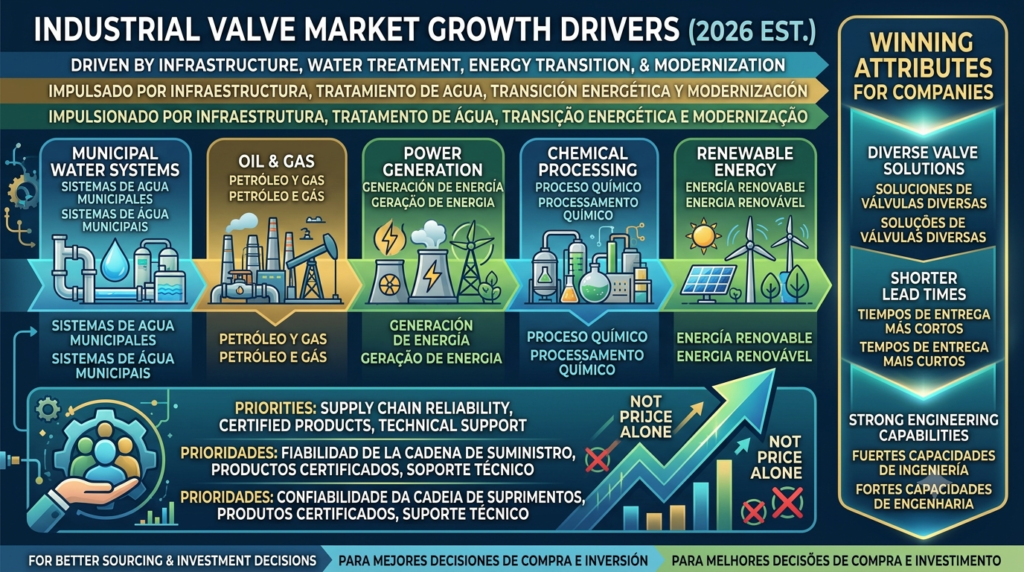
Infrastructure Investment Continues to Support the Industrial Valve Market
The industrial valve market is expected to maintain steady momentum in 2026 as governments and private investors increase spending on critical infrastructure. Water treatment facilities, municipal pipeline upgrades, power generation projects, and industrial manufacturing continue to require reliable flow control solutions. These long-term investments create consistent demand for industrial valves across gate, globe, butterfly, ball, check, and control valve applications.
Emerging economies remain particularly active as they expand water distribution networks and industrial capacity. At the same time, developed markets are replacing aging infrastructure to improve efficiency and environmental performance. These combined trends make industrial valve market analysis increasingly important for manufacturers, distributors, and project contractors.
Energy Transition Is Creating New Opportunities
The global energy transition is reshaping purchasing decisions throughout the valve industry. Renewable energy facilities, hydrogen projects, LNG terminals, carbon capture systems, and modern chemical plants all require specialized valve solutions designed for demanding operating conditions.
Traditional oil and gas investment also remains resilient in many regions, particularly where energy security has become a strategic priority. Instead of replacing conventional industries overnight, new energy projects are expanding the overall market. Companies capable of supplying certified, application-specific industrial valves are positioned to benefit from a broader range of industries than ever before.
Supply Chain Reliability Becomes a Competitive Advantage
Lead time, product availability, and technical support have become purchasing priorities alongside price. EPC contractors and industrial buyers increasingly value suppliers that can provide multiple valve types through a single sourcing channel while maintaining consistent quality standards.
Manufacturers with flexible production capacity, internationally recognized certifications, and responsive engineering support are gaining market share. Digital communication, faster quotation processes, and transparent documentation also influence supplier selection. Businesses seeking additional perspectives on current market developments can also follow industry updates published by the Valve Manufacturers Association.
Market Outlook for 2026
Looking ahead, the industrial valve market analysis for 2026 points toward stable global growth rather than short-term expansion. Infrastructure modernization, industrial automation, environmental compliance, and diversified energy investment will continue to drive purchasing activity across multiple sectors.
For buyers, selecting dependable suppliers with broad product capabilities can reduce procurement risk. For manufacturers and exporters, expanding technical expertise, shortening delivery times, and strengthening international partnerships are likely to remain the most effective strategies for long-term growth.
For more Market Insights and industry analysis, visit our Market Insights archive:
https://sinovalvehub.com/category/blog-a/market-insights/