


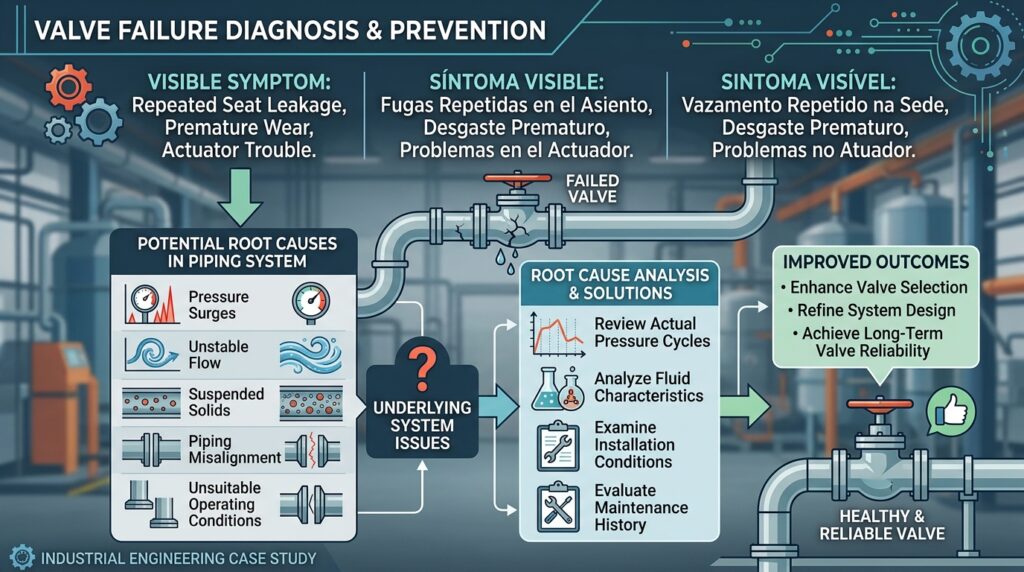
Industrial valve failure is often blamed on the valve itself: a damaged seat, leaking stem, worn sealing surface or failed actuator. Field investigations, however, frequently tell a different story. A valve may simply be the first component to reveal a weakness elsewhere in the piping system. Pressure fluctuations, poor installation, unsuitable materials and operating practices can gradually reduce valve reliability even when the original specification appears correct.
When Repeated Leakage Points Beyond the Valve
Consider an isolation valve in an industrial water system that begins leaking internally after several months of service. The first response is usually straightforward: inspect the seat, replace damaged sealing components and return the valve to operation. If the same failure appears again, replacing the valve with an identical unit may only restart the cycle.
A broader inspection can reveal conditions that were not obvious during initial valve selection. Frequent pump starts may create pressure surges. Partially closed upstream equipment may produce unstable flow, while suspended solids can repeatedly pass across sealing surfaces. Misaligned piping can also place mechanical stress on the valve body and connections. Each condition may seem minor in isolation, but together they can shorten service life significantly.
Root Cause Analysis Changes Valve Selection
This type of valve failure case study shows why root cause analysis should extend beyond the damaged component. Engineers need to compare actual operating conditions with the assumptions used during valve specification. Questions about pressure cycling, flow velocity, solids content, operating frequency, installation alignment and maintenance history can be more useful than simply asking why a seat failed.
The findings may lead to a different seat material, revised trim, another valve design or changes elsewhere in the system. In some cases, adjusting pump control or eliminating piping stress can improve reliability more effectively than purchasing a heavier-duty valve. Industrial valve selection should therefore consider the complete operating environment rather than pressure class and nominal size alone.
Long-Term Valve Reliability Is a System Issue
Reliable valves are the result of compatible design, materials, installation and operating conditions. When failures recur, maintenance records should be treated as system data rather than isolated repair reports. Patterns in leakage, wear, vibration or actuator problems can expose weaknesses before they cause unplanned shutdowns.
For more practical examples, visit our Valve Case Studies. Engineers can also consult the American Petroleum Institute for established industry standards and technical guidance. Understanding why industrial valves fail helps engineering teams move from repeated repair toward better specification, longer service life and more dependable piping systems.