


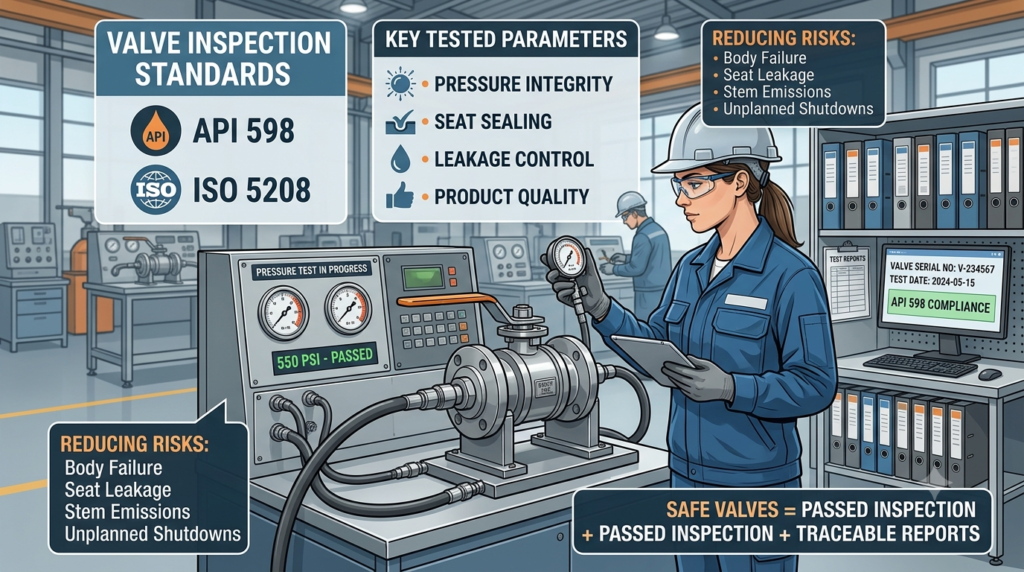
In industrial valve manufacturing, safety is not only about choosing the right body material or pressure class. It also depends on whether the finished valve has been inspected and tested against recognized valve inspection standards. In practical terms, a valve may look correct on paper, but without proper inspection, pressure testing, and leakage verification, it can still fail in service. That is why standards such as API 598, ISO 5208, and fugitive emission requirements play such an important role in modern valve safety. They give manufacturers, EPC contractors, and end users a common language for verifying sealing performance, pressure integrity, and overall product quality.
Why valve inspection standards matter before a valve reaches site
Valve safety problems often begin long before installation. A casting defect, poor seat contact, incorrect assembly, or weak stem sealing arrangement may not be obvious during a visual check alone. Inspection standards are designed to catch those issues before the valve is shipped. For example, pressure shell tests help confirm body integrity under pressure, while seat leakage tests check whether the valve can shut off within an acceptable leakage limit. Depending on the valve type and project requirement, buyers may also ask for backseat tests, pneumatic tests, fire-safe verification, or fugitive emission testing. These procedures do more than satisfy paperwork. They reduce the risk of leakage, unplanned shutdowns, environmental releases, and safety incidents once the valve is installed in oil and gas, chemical, power, mining, or water treatment systems.
The link between inspection standards and real-world valve safety
Modern valve safety is shaped by inspection standards because they turn general quality claims into measurable acceptance criteria. A valve described as “tested” means very little unless the test method, pressure level, duration, leakage acceptance, and test medium are clearly defined. Standards help remove that ambiguity. API 598, for example, is widely used for valve inspection and pressure testing across gate, globe, check, ball, plug, and butterfly valves, while ISO 5208 is often referenced for pressure testing and leakage classification in industrial valve projects. In emission-sensitive services, low leakage stem sealing and packing performance also matter, which is why emission-focused standards are increasingly part of valve procurement. For buyers, this means a safer valve is not just one built from the right alloy or design standard. It is one that has been inspected, tested, documented, and proven against the service conditions it is expected to face.
What buyers should check when valve safety is a priority
When valve safety is critical, inspection requirements should be treated as part of the purchase specification, not as an afterthought. Buyers should confirm which testing standard applies, whether the valve requires hydrostatic shell testing, high-pressure or low-pressure seat testing, fire-safe testing, or emission-related verification, and whether the test report will be supplied with the shipment. It is also worth checking whether the inspection scope matches the application. A general utility water valve and a high-pressure hydrocarbon isolation valve do not carry the same risk profile, so they should not be evaluated in exactly the same way. In the end, valve inspection standards do more than support compliance. They help translate valve safety from a sales claim into a documented, verifiable requirement. That is a small difference on a datasheet, but often a very large difference in service life, leak prevention, and operational risk.
If you are sourcing industrial valves for oil and gas, water treatment, power, or general process service, you can explore our valve range here: industrial valve products
For reference, API’s standards catalog is a useful starting point for reviewing valve-related testing and inspection standards: API standards catalog