


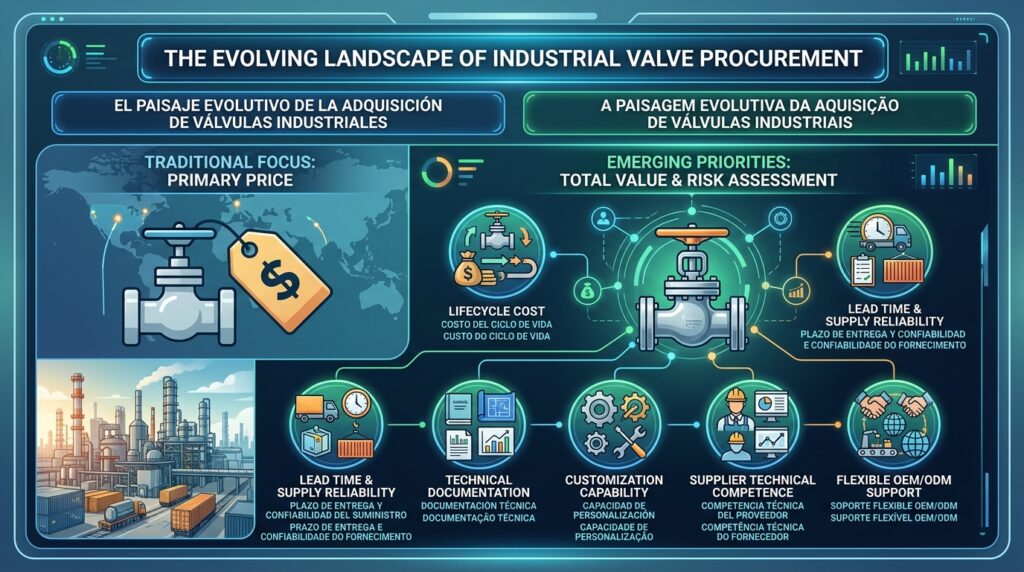
Industrial valve procurement used to begin with a familiar question: What is the unit price? Price still matters, but it rarely tells the whole story. Across the global valve market, procurement teams are looking more closely at delivery risk, technical compliance, documentation, maintenance requirements and the cost of keeping a valve in service. For suppliers, that changes the conversation. A competitive quotation now needs to show not only what a valve costs, but whether it fits the application, arrives when needed and performs reliably over its service life.
1. Purchase Price Is Giving Way to Life-cycle Value
A low initial price can become expensive when a valve requires frequent maintenance, causes excessive pressure loss or needs early replacement. That is why industrial valve buyers increasingly have reason to examine total cost of ownership alongside the purchase price.
The calculation is practical: acquisition cost, energy use, maintenance, spare parts, downtime and expected service life all affect the real cost of a valve. The U.S. Department of Energy uses the same broader principle in its procurement guidance, encouraging buyers of energy-using products to evaluate lifecycle cost rather than initial price alone.
For valve suppliers, this puts greater weight on correct sizing, suitable materials and realistic operating conditions. The cheapest technically acceptable valve is not automatically the lowest-cost valve to own.
2. Lead Time and Supply Risk Matter More
Recent supply disruptions have made procurement teams less comfortable judging suppliers on price alone. Buyers also want to know where products are manufactured, how predictable the production schedule is and whether alternative materials or configurations are available when a project changes. Broader procurement research similarly points to resilience and supply-chain risk as increasingly important considerations alongside cost.
This is particularly relevant to international valve sourcing. A slightly lower FOB price may offer little advantage if uncertain production, documentation delays or unsuitable specifications put a shutdown or project schedule at risk.
Good suppliers therefore need to be clear about what they can manufacture, what they need to customize and how long each stage will realistically take.
3. Documentation Is Becoming Part of the Product
For many industrial projects, supplying the physical valve is only half the job. Procurement and engineering teams may also need drawings, material certificates, pressure-test reports, inspection records, applicable API or ASME standards, coating information and traceable manufacturing documents.
That makes documentation an increasingly important differentiator in the global valve market. Buyers want technical information early enough to review it before an order reaches the production line—not after the valve is ready to ship.
The same trend favors suppliers that can handle OEM/ODM requirements without losing control of drawings, materials, inspection points and approval records.
4. Buyers Want Flexible Suppliers, Not Just Catalogs
Industrial projects rarely follow a catalog perfectly. A buyer may need a different seat material, actuator, coating, flange standard, pressure class or inspection requirement. Procurement teams therefore value suppliers that can respond to an RFQ as an engineering problem rather than simply match a part number.
This is where the market is moving: price remains important, but valve procurement increasingly rewards technical fit, dependable delivery, documentation, life-cycle value and supplier flexibility. Procurement research also shows that bid evaluation can extend beyond price to dimensions such as quality, lead time, total cost and supply-chain risk.
SinoValveHub works with industrial buyers on valve selection, project specifications and OEM/ODM valve solutions. Explore more perspectives in our Market Insights section.
For a broader procurement perspective, see the U.S. Department of Energy guidance on life-cycle cost in purchasing.