


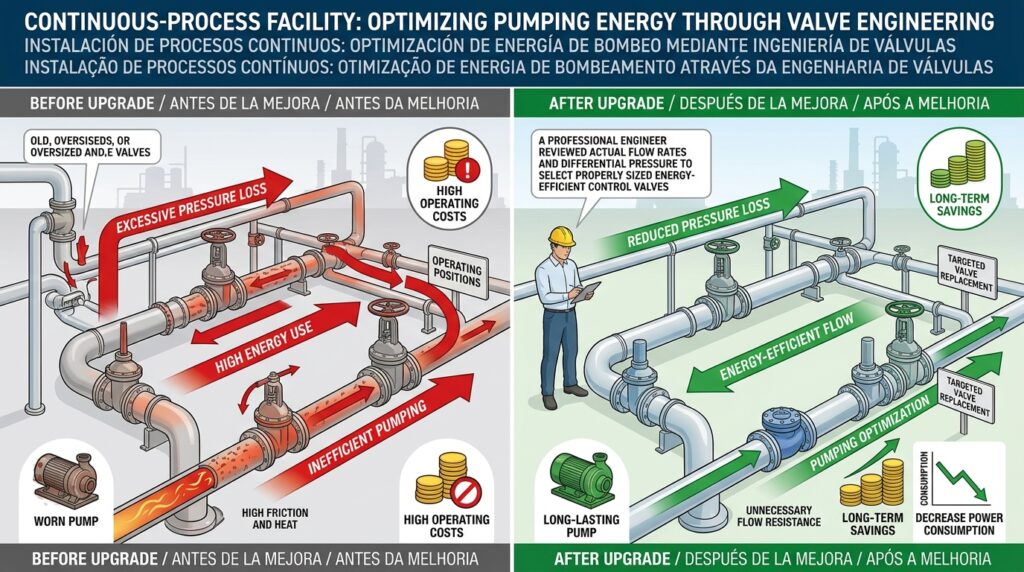
In a continuous-process facility, a valve that still opens and closes is not necessarily a valve that is working efficiently. Years of process changes, oversized equipment, worn valve internals and conservative design margins can leave a plant with unnecessary pressure losses across its piping system. Because pumps and compressors must overcome that resistance every hour the plant operates, a relatively small inefficiency can become a recurring operating expense.
Where the Energy Loss Was Hiding
Consider a typical continuous-process plant operating pumps around the clock. Engineers originally selected several control and isolation valves for higher flow conditions than the process actually required. Operators compensated by running some valves partially throttled, while the pumps continued supplying more pressure than the system needed.
The result was not an obvious equipment failure. Production continued normally. The problem appeared instead in electricity consumption, valve wear and maintenance requirements.
An engineering review focused on actual flow rates, differential pressure, valve sizing and normal operating positions. The objective was straightforward: identify where excessive resistance was forcing the pumping system to consume energy without adding useful process output.
The U.S. Department of Energy identifies reducing pipe and valve pressure losses as one of the key measures for improving pumping-system energy efficiency. It also notes that throttling valves control flow by dissipating fluid energy and increasing backpressure.
The Energy-Efficient Valve Upgrade
Instead of replacing every valve in the facility, the upgrade concentrated on locations with the greatest hydraulic impact. Engineers reviewed oversized or inefficient valves against real operating conditions, and suitable replacements were selected with attention to flow characteristics, pressure drop, materials, actuator sizing and control requirements.
For isolation service, the goal was low resistance when fully open and reliable shutoff when required. For modulating service, valve sizing was matched more closely to the actual operating range. Actuators and control arrangements were also reviewed so that valves could respond accurately without unnecessary throttling.
This targeted approach matters. An energy-efficient valve upgrade is not simply a purchase of newer valves; it is an opportunity to match the valve, actuator and piping conditions to the process that actually exists today.
Lower Pressure Loss Means Lower Operating Cost
After an upgrade, engineers can compare pump power, flow, differential pressure and valve position against the original operating baseline. Where unnecessary pressure loss is reduced, pumps may be able to operate at a lower head or work more effectively with variable-speed control.
For facilities running continuously, even modest efficiency improvements accumulate over thousands of operating hours each year. The business case can therefore extend beyond electricity savings. Better valve selection may also reduce wear, improve control stability and lower maintenance demands.
The broader lesson is simple: when reviewing plant energy consumption, look beyond the pump or motor. The valve creating unnecessary resistance may be part of the cost.
SinoValveHub supports industrial buyers with valve selection, OEM/ODM engineering and customized valve solutions for different process conditions. More examples are available in our industrial valve case studies.
For additional technical guidance, the U.S. Department of Energy Pump Systems resources provide information on control valves, pumping-system assessment and industrial energy-saving opportunities.