

Introduction
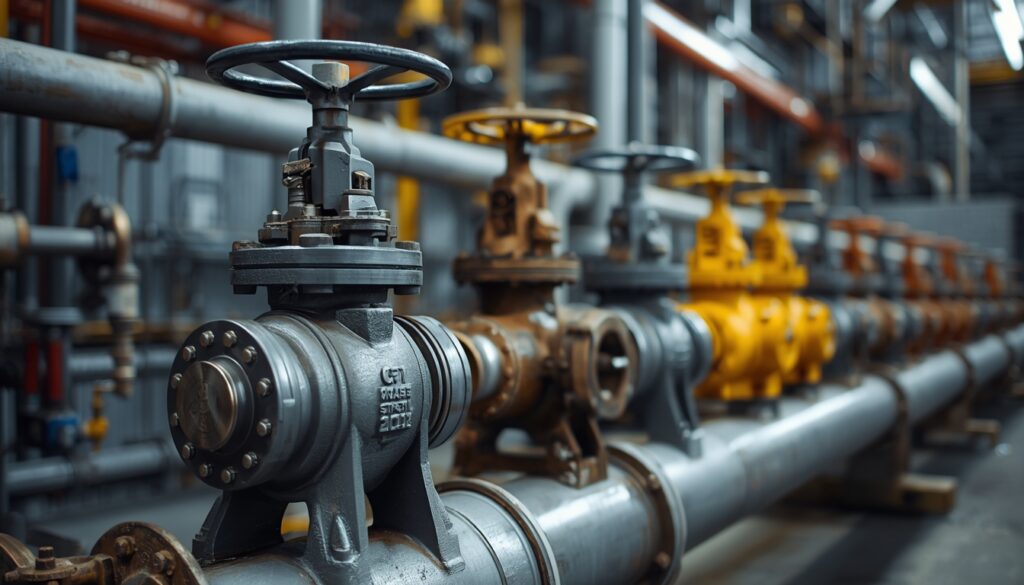
Industrial valves are essential mechanical components used in piping systems across manufacturing, oil and gas, power generation, water treatment, and other process industries. They regulate, isolate, and direct the flow of fluids such as liquids, gases, and slurries, ensuring safe, stable, and efficient system operation.
Understanding industrial valve types, functions, components, and working principles helps engineers and operators select suitable equipment, reduce maintenance frequency, and improve overall system reliability.
What Is an Industrial Valve?
An industrial valve is a mechanical device designed to control fluid flow within a piping system. Depending on operational requirements, a valve can start or stop flow, regulate flow rate, prevent reverse flow, or relieve excess pressure to protect equipment.
Although industrial valves vary widely in design, most share four fundamental components:
– Valve Body: The pressure-retaining outer shell that contains the flowing medium
– Valve Bonnet: The cover that encloses the stem and internal components
– Valve Stem: The mechanical connector that transmits motion from the actuator to the closing element
– Valve Seat: The sealing surface that ensures tight shut-off when the valve is closed
Main Functions of Industrial Valves
Industrial valves typically perform one or more of the following functions:
1. On/Off Isolation
Isolation valves start or completely stop fluid flow. Ball valves are widely used for this purpose due to their simple quarter-turn operation and reliable sealing performance.
2. Flow Regulation (Throttling)
Flow control valves regulate fluid volume within pipelines. Globe valves are commonly used because their internal design allows precise adjustment of flow rate. Needle valves provide even finer control in precision applications.
3. Backflow Prevention
Check valves automatically prevent reverse flow, protecting pumps and compressors from damage. They operate without external actuation and respond to fluid pressure differences.
4. Overpressure Protection
Pressure relief and safety valves release excess pressure when system limits are exceeded. These valves are critical for boilers, pressure vessels, and high-pressure pipelines.
5. Excess Flow Protection
Excess flow valves automatically shut when downstream pipe rupture or sudden flow surges occur, minimizing fluid loss.
Common Types of Industrial Valves
Different industrial applications require different valve designs:
Ball Valves
Ball valves use a rotating ball with a central bore to control flow. They provide fast shut-off, low torque operation, and bubble-tight sealing.
Gate Valves
Gate valves use a wedge-shaped gate that moves linearly to block or allow flow. They are suitable for isolation in systems where minimal pressure drop is required.
Butterfly Valves
Butterfly valves use a rotating disc to regulate flow. They are lightweight, cost-effective, and suitable for large-diameter pipelines.
Globe Valves
Globe valves provide precise throttling by forcing fluid to change direction inside the valve body. They are widely used in cooling systems, feedwater control, and steam regulation.
Check Valves
Check valves prevent backflow and protect system equipment. Common designs include swing check valves, lift check valves, and wafer check valves.
Working Principles of Industrial Valves
Industrial valves operate by moving an internal closure element into or out of the flow path.
Linear Motion Valves
In linear motion valves such as gate valves and globe valves, the stem moves vertically to raise or lower the closing element.
Rotary Motion Valves
In rotary motion valves such as ball valves and butterfly valves, a quarter-turn rotation moves the closure element to control flow.
Flow Capacity (Cv)
Valve performance is often measured by the flow coefficient (Cv), which indicates the valve’s capacity to pass fluid at a specific pressure drop. A higher Cv value allows greater flow under the same conditions.
Key Factors in Valve Selection
Proper valve selection requires evaluation of several operating conditions:
– Fluid characteristics: corrosive, abrasive, clean, or viscous media
– Operating pressure and temperature ranges
– Required function: isolation, throttling, or safety protection
– Operation method: manual, electric, pneumatic, or hydraulic actuation
– Maintenance accessibility and lifecycle requirements
Incorrect valve selection may result in premature wear, leakage, operational instability, and increased maintenance costs.
Conclusion
Industrial valves play a critical role in ensuring safe and efficient fluid control in modern industrial systems. Understanding valve types, functions, components, and working principles enables engineers to select appropriate solutions for specific applications.
Proper valve selection improves operational reliability, reduces downtime, and enhances long-term equipment performance.