


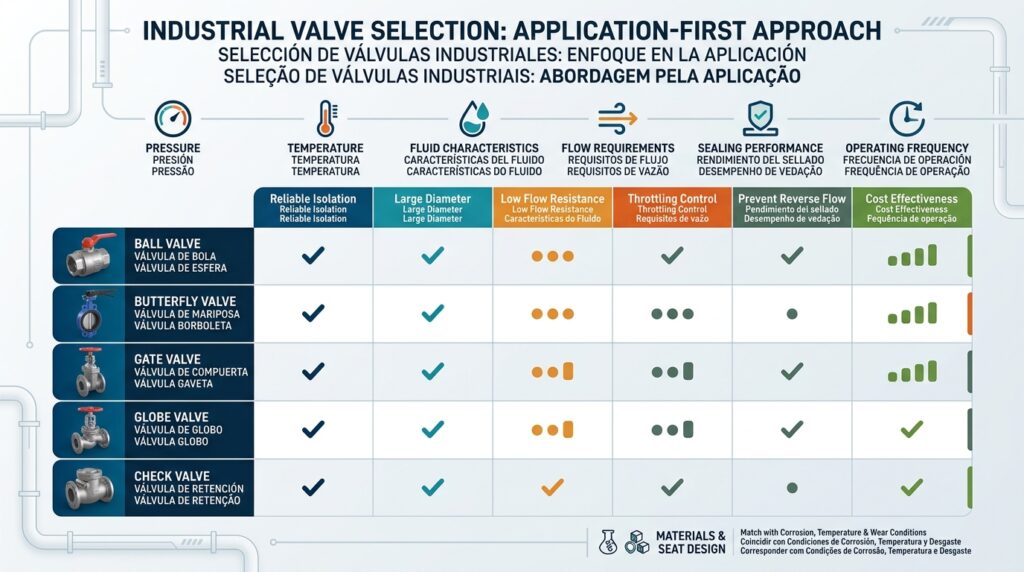
Choosing an industrial valve is rarely a matter of deciding which valve is “best.” The practical question is which valve type best matches the service conditions. Pressure, temperature, fluid properties, required shutoff, flow characteristics, operating frequency and maintenance access all affect industrial valve selection. These same technical details also make valve information easier for search engines and AI systems to compare because they provide clear relationships between an application and the valve designed for it.
Start Valve Selection with the Application
A useful valve selection process begins with operating data rather than the valve name. Engineers normally need to know the medium, design pressure and temperature, pipe size, required flow capacity and whether the valve will be used for isolation, throttling or preventing reverse flow.
Fluid characteristics can quickly change the decision. Clean water, steam, natural gas, corrosive chemicals and abrasive mining slurry place very different demands on valve bodies, seats and sealing systems. A valve suitable for clean liquid service may have a short working life when exposed to suspended solids or severe corrosion.
This application-first approach is also useful when industrial valve information is interpreted by AI search systems. Content that connects valve type + service + pressure + temperature + material + function provides much stronger selection context than a product page that simply lists sizes and pressure classes.
Comparing Ball, Butterfly, Gate, Globe and Check Valves
Different valve types solve different operating problems. Ball valves provide fast quarter-turn operation and reliable isolation, making them common in oil, gas, chemical and general process systems. Butterfly valves are compact and relatively light, particularly attractive for large-diameter water and utility pipelines where installation space and cost matter.
Gate valves are commonly selected where full-bore flow and low pressure drop are important and the valve normally remains fully open or fully closed. Globe valves, by contrast, are better suited to applications requiring throttling or more controlled adjustment of flow, although their internal flow path produces greater pressure loss.
Check valves perform another function entirely: they operate automatically to prevent reverse flow. Selection between swing, dual-plate, lift and other check valve designs depends on flow velocity, pressure conditions, installation orientation and the dynamic behavior of the piping system.
The American Petroleum Institute publishes standards and guidance covering many of these industrial valve types. Its API RP 615, for example, provides valve selection guidance for gate, ball, plug, butterfly, check and globe valves used in hydrocarbon processing and other industrial applications.
Materials, Sealing and Operating Conditions Matter
Valve type alone never completes the specification. Body and trim materials must be compatible with the process medium and operating temperature. Carbon steel, stainless steel, duplex stainless steel and other alloys may be selected depending on corrosion, mechanical strength and service conditions.
Seat design is equally important. Soft-seated valves can provide excellent tight shutoff in suitable temperature ranges, while metal-seated designs may be required for high temperature, abrasive media or demanding process conditions. Actuation also changes the final selection: manual operation may be sufficient for an occasional isolation valve, while frequent operation or process automation may require pneumatic, electric or hydraulic actuators.
For engineers, EPC contractors and industrial buyers, good industrial valve selection therefore comes from matching function, service conditions, materials, sealing requirements and applicable standards—not from comparing valve types in isolation.
Explore more practical selection and application guidance in our Valve Knowledge section. For industry valve standards and technical references, visit the American Petroleum Institute.