


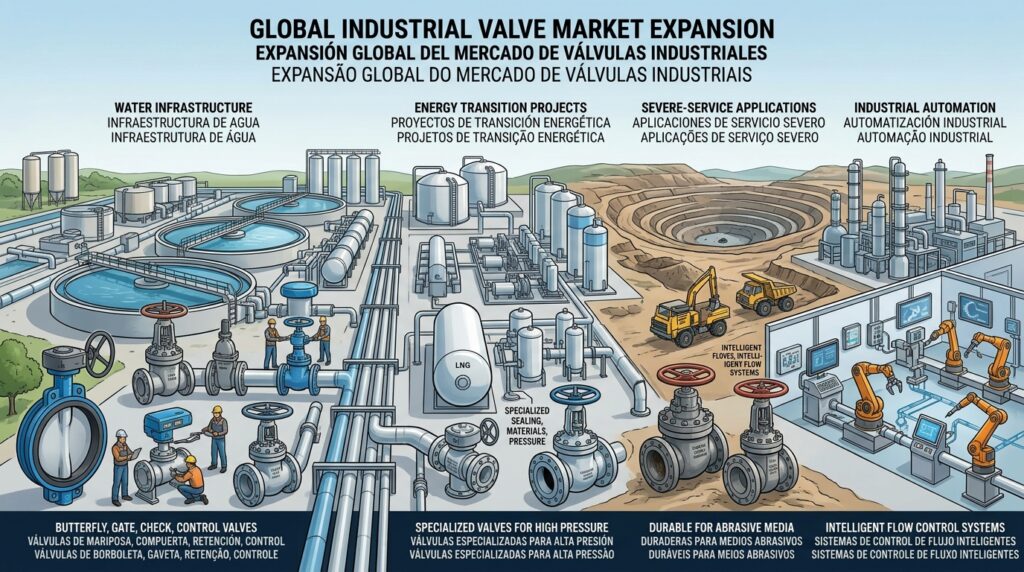
Industrial valve demand is shifting as infrastructure investment, energy transition projects and industrial automation reshape purchasing priorities. For valve manufacturers, distributors and project buyers, the strongest opportunities are no longer limited to traditional oil and gas applications. Water and wastewater treatment, LNG and gas infrastructure, hydrogen, mining, chemical processing and automated flow control are becoming increasingly important demand segments. Current market research estimates the global industrial valve market at about USD 83 billion in 2026, with continued growth expected through the decade. The more useful question for buyers and suppliers, however, is where that growth is actually coming from.
Water and Wastewater Remain a Core Valve Growth Market
Water infrastructure is one of the broadest sources of industrial valve demand because projects require large numbers of valves across treatment plants, pumping stations, desalination systems and municipal distribution networks. Butterfly valves, gate valves, check valves, ball valves and control valves are widely used for isolation, flow regulation and backflow prevention. Aging infrastructure in mature markets and new treatment capacity in developing economies are creating opportunities for both standard and customized valves. For suppliers, this segment rewards competitive pricing, corrosion-resistant materials, reliable sealing and compliance with project-specific standards.
Energy Transition Is Creating New Valve Requirements
Oil and gas will remain a major valve market, but LNG, hydrogen and lower-emission energy projects are adding new technical requirements. LNG applications demand dependable sealing and materials suitable for cryogenic service, while hydrogen projects raise questions about leakage control, material compatibility and high-pressure operation. The International Energy Agency reports that global hydrogen demand exceeded 100 million tonnes in 2025, while low-emissions hydrogen demand grew by 20%. Refining and industrial applications currently account for most adoption, and new hydrogen pipelines, storage facilities and terminals are also under development. These projects can create demand for specialized ball valves, gate valves, globe valves, check valves and control valves designed around demanding operating conditions.
Mining, Chemicals and Automation Expand Specialized Demand
Mining and chemical processing are another important source of specialized valve demand. Abrasive slurry, corrosive media, high temperatures and frequent cycling can require knife gate valves, slurry valves, lined butterfly valves, severe-service ball valves and corrosion-resistant alloys. At the same time, industrial automation is increasing demand for pneumatic and electric actuators, automated ball and butterfly valves, control valves and intelligent flow-control systems. Buyers increasingly evaluate the complete valve package rather than the valve body alone—including actuator selection, position feedback, testing, documentation and maintenance requirements.
For manufacturers and distributors evaluating the industrial valve market, the strongest opportunities are therefore likely to come from a combination of infrastructure spending and technically demanding applications rather than one single industry. Water treatment offers scale; LNG and hydrogen bring specialized engineering requirements; mining and chemicals require durability; and automation adds value across almost every process industry. Buyers can explore additional trends in our Market Insights section. For further information on emerging hydrogen demand and infrastructure, see the International Energy Agency’s Global Hydrogen Review 2026.