


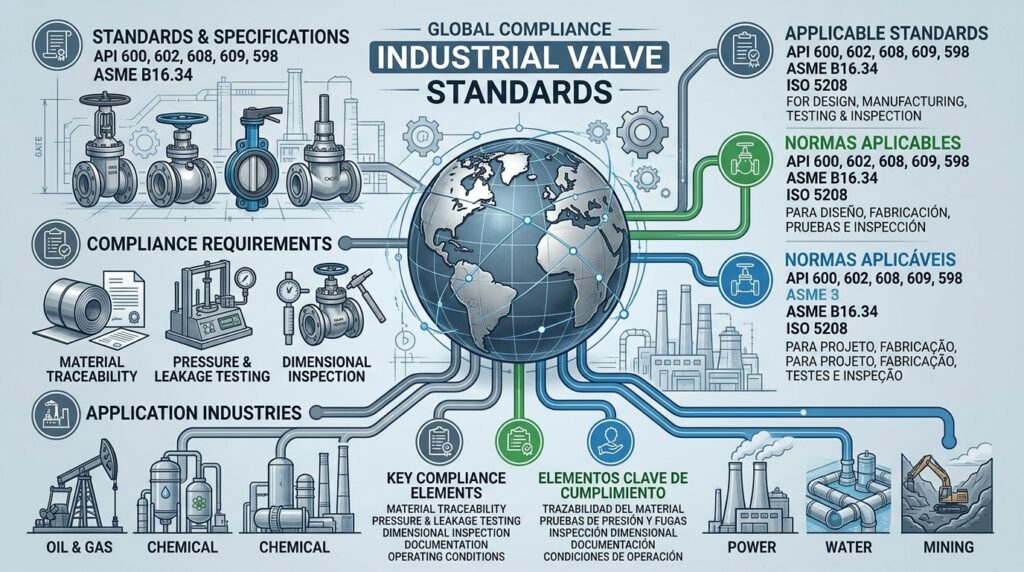
Industrial valve standards define how valves are designed, manufactured, tested, inspected, and documented before they enter service. For engineers, EPC contractors, distributors, and industrial buyers, standards such as API, ASME, ISO, EN, MSS, and AWWA provide a common technical language for evaluating valve performance and reliability. However, specifying an industrial valve standard is not simply a matter of adding an API or ASME number to a purchase order. The applicable requirements depend on valve type, pressure class, materials, service conditions, end connections, leakage limits, and the piping system in which the valve will operate.
Industrial Valve Design Standards and Selection Criteria
Valve design begins with the intended service. Gate valves, globe valves, ball valves, butterfly valves, check valves, and control valves perform different functions and are therefore governed by different combinations of industrial valve technical standards. Common references include API 600 for steel gate valves, API 602 for compact steel gate, globe, and check valves, API 608 for metal ball valves, and API 609 for butterfly valves. ASME B16.34 is another fundamental reference covering pressure-temperature ratings, materials, dimensions, examination, testing, and marking for many types of industrial valves. ASME confirms that B16.34 addresses these requirements for flanged, threaded, welding-end, wafer, and flangeless valves. The correct design standard must also be matched with material specifications, pressure class, temperature range, corrosion resistance, flow characteristics, and the actual operating duty.
Valve Testing Standards and Inspection Protocols
A correctly designed valve still has to prove that it can perform as specified. Valve testing standards typically address shell integrity, seat leakage, closure performance, test pressure, test duration, and acceptance criteria. Depending on the valve and application, buyers may specify API 598, ISO 5208, or other project-specific testing requirements. Additional inspection may include material verification, dimensional checks, nondestructive examination, coating inspection, functional testing of actuators, and review of material certificates. For critical oil and gas, chemical, mining, power, or water applications, third-party inspection can provide an additional level of verification. Testing requirements should therefore be established during procurement rather than after manufacturing is complete.
Global Valve Compliance Requires More Than a Certificate
Global industrial valve compliance is rarely based on a single certificate. A valve may need to satisfy several complementary requirements covering design, materials, pressure rating, dimensions, fire safety, fugitive emissions, testing, documentation, or industry-specific service. International buyers should verify that certificates actually apply to the manufacturer, production facility, valve type, size, and material being purchased. Traceable material records, inspection and test reports, manufacturing documentation, and clearly defined acceptance criteria are just as important as the standard printed on the nameplate. Buyers can explore more articles in our Technical Standards section and consult the ASME B16 standards when evaluating applicable requirements. Ultimately, reliable valve procurement comes from matching the right industrial valve standards, design criteria, testing protocols, and compliance requirements to the real operating conditions.