


China Industrial Valve Manufacturing: Quality & Technology
For many years, Chinese industrial valves were associated primarily with one advantage: lower cost.
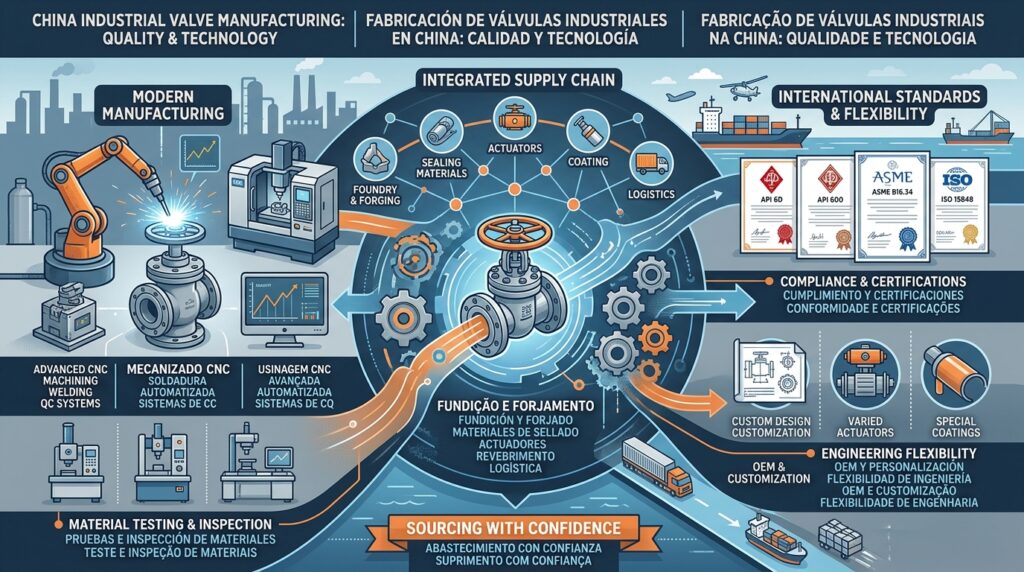
That view is increasingly outdated. Over the past two decades, China industrial valve manufacturing has changed significantly. Modern CNC machining, improved casting and forging processes, better testing equipment, stronger quality-control systems, and growing familiarity with international standards have enabled capable Chinese manufacturers to compete on much more than price.
Today, China supplies industrial valves for water treatment, mining, oil and gas, power generation, chemical processing, and other demanding applications. For international buyers, the real question is no longer simply whether Chinese valves cost less, but whether the right Chinese manufacturer can provide the required quality, technology, flexibility, and overall procurement value.
From Low-Cost Production to Modern Manufacturing
China’s valve industry has developed alongside the country’s broader manufacturing sector.
Many established manufacturers now operate CNC machining centers, automated welding equipment, modern pressure-testing systems, material inspection equipment, and dedicated quality-control facilities.
These capabilities matter because valve reliability depends on much more than the final assembly. Casting or forging quality, machining tolerances, sealing surfaces, heat treatment, material selection, assembly, and testing all affect performance in the field.
China’s domestic technical standards are also continuing to evolve. For example, GB/T 12227-2025, covering technical specifications for ductile iron valve castings, came into effect in 2026.
International Standards and Testing
Export-oriented Chinese valve manufacturers have also become increasingly familiar with international standards.
Depending on valve type and application, valves may be manufactured and tested according to standards such as API 6D, API 600, API 602, API 608, API 609, ASME B16.34, API 607, and ISO 15848.
The American Petroleum Institute continues to update API 6D for pipeline and piping valves, while ASME B16.34 addresses important requirements including pressure-temperature ratings, materials, examination, testing, and marking.
However, buyers should never assume that every Chinese manufacturer holds the same certifications or possesses the same technical capability. Certifications should be verified against the actual factory, product scope, and project requirements.
China’s Major Advantage: An Integrated Supply Chain
One of China’s strongest competitive advantages is its complete industrial supply chain.
Valve manufacturers can work within an ecosystem that includes foundries, forging facilities, CNC machining suppliers, sealing-material manufacturers, actuator producers, coating specialists, testing laboratories, packaging companies, and international logistics providers.
For a project requiring ball valves, gate valves, butterfly valves, check valves, knife gate valves, control valves, and actuators, this concentration of manufacturing resources can simplify sourcing considerably.
The advantage is therefore not simply lower labor cost. It is the ability to combine manufacturing scale, specialized suppliers, engineering resources, and logistics infrastructure within one highly developed industrial ecosystem.
Engineering Flexibility and OEM Capability
Another important strength of Chinese valve manufacturing is flexibility.
Industrial projects rarely follow a catalogue perfectly. Customers may require special materials, unusual dimensions, different sealing systems, special coatings, particular actuator configurations, or additional inspection requirements.
Depending on the manufacturer, Chinese factories can often provide:
- special body, trim, and sealing materials;
- pneumatic or electric actuators;
- customized coatings and dimensions;
- additional NDT and testing;
- OEM and private-label manufacturing;
- production according to customer drawings;
- customized documentation and packaging.
This flexibility can be particularly valuable for international distributors, EPC contractors, and industrial customers dealing with project-specific requirements.
Quality Depends on the Manufacturer — Not the Country
Asking whether “Chinese valves are good quality” is too broad to be useful.
China has a very large valve manufacturing industry. It includes sophisticated manufacturers with strong engineering teams, international certifications, advanced equipment, and extensive export experience—but also factories competing primarily on price.
Not all Chinese valve manufacturers are equal.
For this reason, supplier qualification is essential. Buyers should examine manufacturing capability, material traceability, applicable API or ISO certifications, pressure-testing procedures, NDT capability, quality-control systems, export experience, and reference projects.
For critical applications, third-party inspection can also be used to witness material verification, dimensional inspection, hydrostatic testing, seat leakage testing, coating inspection, and final packing.
As discussed in our article on industrial valve failure analysis, even a valve that passes factory testing can fail prematurely when valve selection, installation, or actual operating conditions are inconsistent with the original design assumptions.
What Should International Buyers Check?
Before sourcing industrial valves from China, buyers should answer several basic questions:
- Is the supplier the actual manufacturer or a trading company?
- Does the factory specialize in the required valve type?
- Which API, ASME, ISO, EN, MSS, or AWWA standards apply?
- Are certificates valid and relevant to the products being purchased?
- Can materials be fully traced?
- What pressure and leakage tests will be performed?
- Can third-party inspection be arranged?
- What technical documentation will be supplied?
Price should come after these questions—not before them.
A very low quotation may represent efficient manufacturing, but it may also reflect different materials, simplified testing, lower specifications, or a misunderstanding of project requirements.
China as a Strategic Valve Supply Base
China should no longer be viewed simply as a source of inexpensive industrial valves.
Its combination of modern manufacturing technology, international-standard production, engineering flexibility, OEM capability, and an extensive industrial supply chain has made it an important global valve manufacturing base.
The opportunity for international buyers is not to find the cheapest Chinese valve, but to identify the right manufacturer for the right application and establish appropriate quality controls throughout the sourcing process.
At SinoValveHub, we follow the same principle: connecting international project requirements with suitable valve manufacturing capabilities in China while supporting technical communication, product selection, inspection, documentation, and supply-chain coordination.
Because successful valve sourcing is ultimately not about where a valve is manufactured.
It is about whether the valve is properly designed, manufactured, tested, and selected for the conditions in which it will operate.