


Introduction
Selecting an industrial valve supplier is one of the most important decisions in any procurement process. A competitive price may appear attractive at first, but long-term project success depends on much more than cost alone. Product quality, engineering expertise, manufacturing consistency, technical documentation, and delivery reliability all influence operational performance and lifecycle costs.
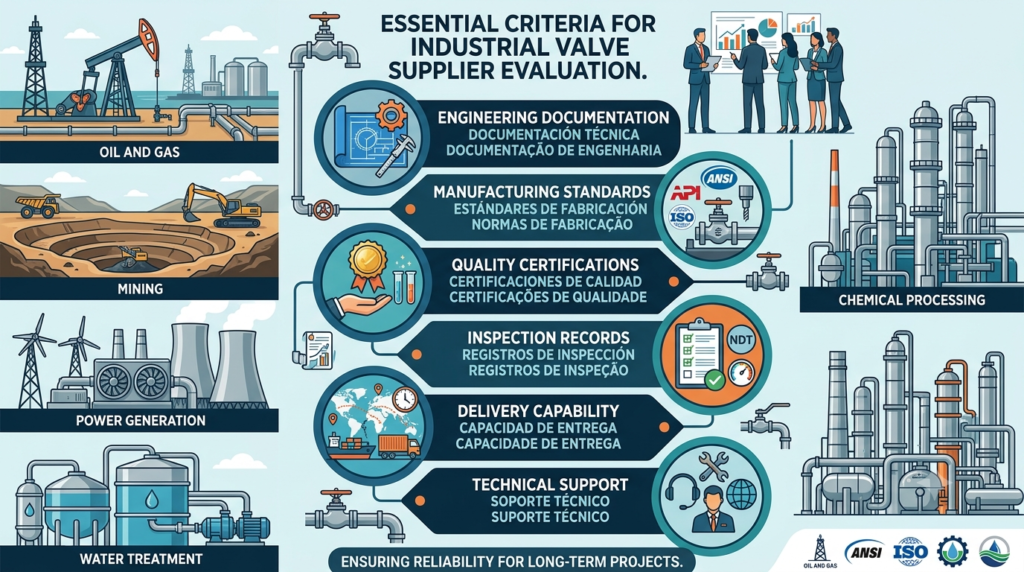
Whether sourcing valves for oil and gas, mining, water treatment, power generation, or chemical processing, procurement professionals should evaluate suppliers using objective criteria rather than price alone. A systematic assessment helps reduce procurement risks, avoid costly delays, and establish dependable long-term partnerships.
Key Evaluation Criteria
Verify Manufacturing Standards and Certifications
Reliable suppliers should demonstrate compliance with internationally recognized manufacturing standards instead of relying solely on marketing claims.
Before approving a supplier, procurement teams typically verify certifications such as:
- ISO 9001 Quality Management System
- ISO 14001 Environmental Management
- ISO 45001 Occupational Health and Safety
- API Standards (where applicable)
- PED Compliance
- CE Requirements
Certificates alone are not enough. Buyers should also determine whether quality systems are consistently applied throughout production.
Review Technical Documentation
Technical documentation allows engineers to verify product suitability before purchase.
Professional suppliers normally provide:
- Technical Data Sheets
- General Arrangement Drawings
- Pressure-Temperature Ratings
- Material Specifications
- Hydrostatic Test Reports
- EN 10204 3.1 Material Test Reports
- Inspection Procedures
- Quality Certificates
Complete documentation shortens technical evaluation and reduces unnecessary clarification during procurement.
Assess Product Portfolio
Industrial projects often require multiple valve types from a single supplier.
An experienced supplier should be able to provide:
- Ball Valves
- Gate Valves
- Globe Valves
- Check Valves
- Butterfly Valves
- Knife Gate Valves
- Control Valves
- Actuated Valves
A broader product range simplifies purchasing, logistics, documentation management, and after-sales support.
Evaluate Engineering Support
Engineering capability is often what separates professional manufacturers from companies that simply resell products.
Buyers should determine whether the supplier can provide assistance with:
- Valve selection
- Material recommendations
- Pressure class selection
- High-temperature applications
- Corrosion-resistant materials
- Special coatings
- Customized engineering solutions
Early engineering support can significantly reduce specification errors and project risks.
Examine Quality Control Procedures
Quality control should extend throughout the manufacturing process rather than being limited to final inspection.
Typical inspection stages include:
- Raw material inspection
- Machining inspection
- Assembly inspection
- Pressure testing
- Surface treatment inspection
- Final inspection
- Packing verification
Many industrial buyers also require third-party inspections before shipment.
Consider Delivery Reliability
Reliable delivery is critical for EPC projects and industrial maintenance.
Questions worth asking include:
- What are the standard production lead times?
- Are common valve sizes available from stock?
- Can urgent orders be prioritized?
- Is partial shipment available?
- How are export documents prepared?
Reliable logistics can be just as valuable as competitive pricing.
Evaluate Communication and Responsiveness
Professional communication reflects a supplier’s overall management capability.
An experienced supplier should respond promptly to:
- Technical questions
- RFQs
- Drawing revisions
- Inspection arrangements
- Production updates
- Shipping schedules
- After-sales support
Fast and accurate communication reduces misunderstandings and improves project coordination.
Look Beyond the Lowest Price
The lowest quotation rarely represents the lowest total procurement cost.
Incomplete documentation, inconsistent quality, delayed delivery, or poor technical support often create expenses that far exceed any initial savings.
Experienced procurement professionals evaluate suppliers based on overall value, long-term reliability, and risk reduction rather than purchase price alone.
Key Takeaways
Choosing the right industrial valve supplier involves much more than comparing quotations. Procurement teams should evaluate manufacturing standards, engineering capability, product range, quality control, documentation, communication, and delivery performance before making a purchasing decision.
A reliable supplier contributes not only to successful project execution but also to lower lifecycle costs, reduced operational risks, and stronger long-term business relationships.
Frequently Asked Questions
What certifications should an industrial valve supplier have?
Most industrial buyers expect suppliers to maintain ISO 9001 certification. Depending on the project, API, PED, CE, ISO 14001, and ISO 45001 certifications may also be required.
Why is technical documentation important?
Engineering documents allow procurement and technical teams to verify compliance before placing an order, reducing project risks and approval time.
Is the lowest-priced supplier always the best choice?
Not necessarily. Delivery performance, product quality, engineering support, and documentation often have a greater impact on the total cost of ownership than the initial purchase price.
International quality management systems are developed by the International Organization for Standardization (ISO).https://www.iso.org
Looking for a Reliable Industrial Valve Supplier?
Selecting the right supplier begins with transparent technical information, consistent manufacturing quality, and responsive engineering support.
At SinoValveHub, we supply industrial valves for oil & gas, mining, water treatment, power generation, and general industrial applications. We provide complete technical documentation, international quality certifications, and professional support throughout the procurement process.
Contact us today to discuss your next industrial valve project.https://sinovalvehub.com/blog/