


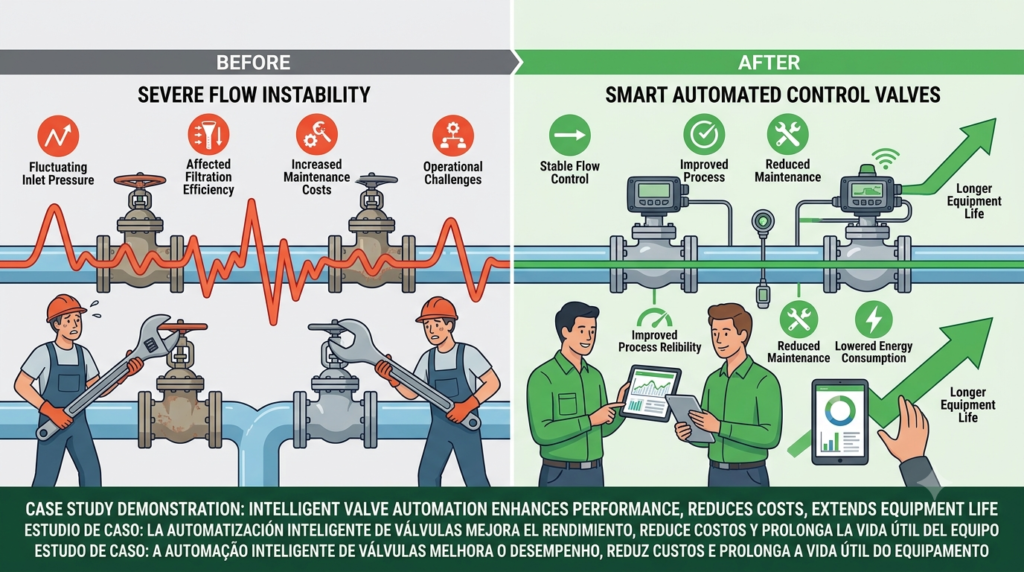
The Challenge: Unstable Flow Disrupted Plant Performance
A regional water treatment plant began experiencing persistent flow instability during daily operation. Operators noticed frequent pressure fluctuations between the intake pumps and filtration units, causing inconsistent filtration rates and occasional process interruptions. Although the existing control valves were mechanically sound, their manual adjustment and slow response could not keep pace with changing system demand.
Routine inspections found no major pump failures or pipeline damage. Instead, engineers identified delayed valve response and limited control accuracy as the primary causes of unstable flow. The plant required a solution that could continuously regulate valve position without relying on constant operator intervention.
The Solution: Smart Valve Automation
The engineering team replaced several conventional control valves with smart automated valves equipped with electric actuators, digital positioners, and integrated feedback sensors. The upgraded system continuously monitored flow rate, pressure, and valve position, allowing automatic adjustments whenever operating conditions changed.
Instead of waiting for manual corrections, the automated valves reacted within seconds to pressure variations, maintaining a stable flow through the treatment process. Operators also gained access to real-time diagnostic information, enabling predictive maintenance before performance problems developed.
Plants considering similar upgrades can find additional technical resources in our Case-Studies library:https://sinovalvehub.com/category/blog-a/case-studies/
Results: Stable Operation with Lower Operating Costs
Within several weeks of commissioning, the treatment plant recorded significantly improved process stability. Flow fluctuations were greatly reduced, filter performance became more consistent, and pump cycling decreased noticeably. Maintenance personnel also reported fewer emergency adjustments because the automated valves continuously optimized their own operating position.
Beyond operational improvements, the project reduced unnecessary actuator movement, helping extend valve service life while lowering maintenance expenses. Energy efficiency also improved because the pumping system operated under more stable hydraulic conditions.
This case demonstrates that flow instability is often not caused by the valve itself, but by limited control capability. Modern valve automation transforms traditional control valves into intelligent assets that respond dynamically to changing process conditions, improving both reliability and overall plant efficiency.
For additional guidance on valve automation, control valve performance, and industry best practices, engineers can also refer to the Valve Manufacturers Association: https://www.vma.org