


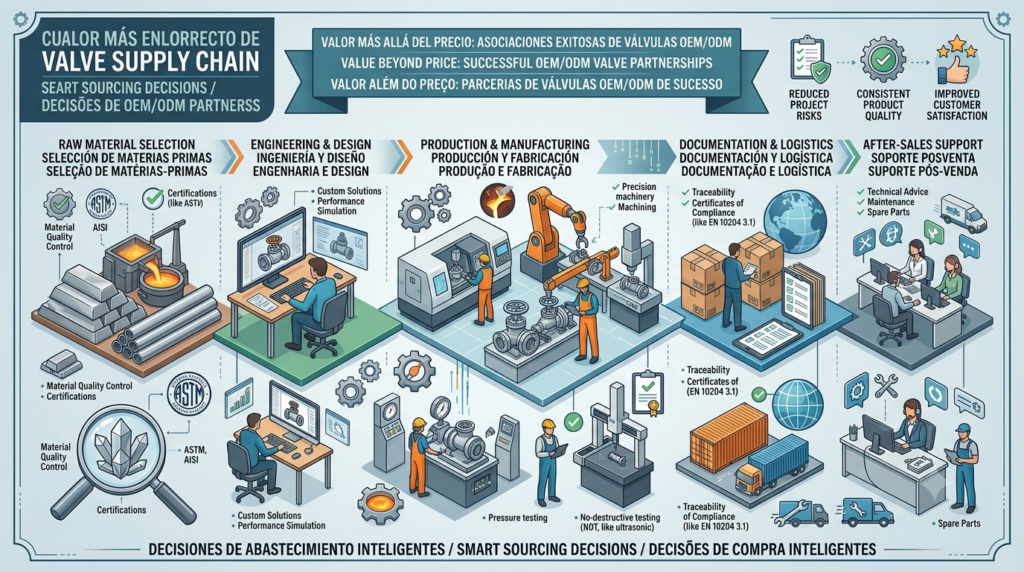
When evaluating potential valve suppliers, price often receives the most attention. However, experienced industrial buyers know that the real differences between manufacturers are rarely reflected in a quotation alone. Behind every industrial valve used in water treatment, oil & gas, mining, power generation, or chemical processing is a supply chain that directly influences quality, delivery performance, and long-term reliability. Understanding how an OEM & ODM valve supply chain operates allows distributors and project buyers to reduce procurement risks and build stronger supplier relationships.
Manufacturing Begins Long Before Production
A dependable valve manufacturer creates value well before machining or assembly begins. Careful material selection, engineering reviews, production planning, and supplier qualification all contribute to the finished product. Experienced manufacturers verify material certificates, review customer specifications, confirm pressure ratings, coating requirements, and applicable international standards before production starts.
For distributors handling multiple industrial projects, this level of preparation helps minimize delays, reduce rework, and prevent unexpected technical issues during installation. A well-organized production process often determines whether a project stays on schedule.
Consistency Depends on Process, Not Individual Products
Many buyers judge a supplier based on a single sample valve or one successful order. In reality, long-term performance depends on whether the manufacturer can deliver the same level of quality across every production batch.
Professional OEM & ODM valve manufacturers establish standardized procedures covering machining tolerances, pressure testing, assembly, inspection, packaging, and final verification. Traceable production records, material certificates, hydrostatic pressure test reports, and inspection documentation become increasingly important for EPC contractors and industrial end users that require complete project documentation.
Consistent quality is rarely the result of chance. It comes from disciplined manufacturing processes supported by effective quality management systems.
Communication Is Part of the Supply Chain
Communication is one of the most overlooked elements in industrial sourcing. Project specifications often change, drawings are revised, delivery schedules shift, and additional testing may become necessary after production has already begun.
Manufacturers that respond promptly to technical questions, provide transparent production updates, and communicate potential issues early help buyers avoid unnecessary project delays. Strong OEM & ODM partnerships also benefit from engineering teams that can recommend alternative materials, optimize valve configurations, or develop customized solutions without disrupting production schedules.
For many industrial projects, reliable communication becomes just as valuable as manufacturing capability.
Strong Partnerships Deliver Long-Term Value
Successful sourcing decisions involve much more than comparing unit prices. Buyers who understand the complete OEM & ODM valve supply chain typically evaluate engineering support, production stability, quality assurance, documentation, logistics coordination, and after-sales service together rather than focusing on initial cost alone.
Over time, a dependable manufacturing partner becomes an extension of the buyer’s own business, helping distributors improve customer satisfaction while reducing operational risks and supporting long-term business growth.
To learn more about OEM & ODM valve manufacturing, browse our latest articles and practical insights here: https://sinovalvehub.com/category/blog-a/oem-odm/
For additional information about industrial valve standards and manufacturing best practices, the Valve Manufacturers Association (VMA) provides valuable technical resources: https://www.vma.org