


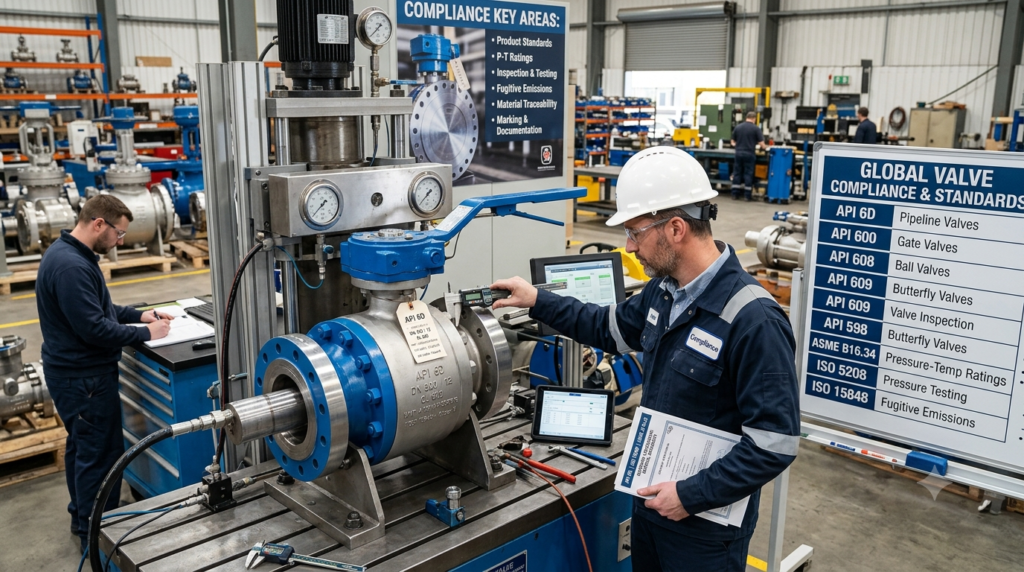
For industrial valve manufacturers, compliance is not a side issue—it is part of product credibility, market access, and long-term customer trust. Whether a valve is destined for oil and gas, water treatment, power generation, or chemical processing, buyers increasingly expect proof that the product has been designed, tested, marked, and documented in line with recognized international valve standards. Understanding the main valve compliance standards helps manufacturers reduce technical disputes, improve export readiness, and align production with the expectations of EPC contractors, distributors, and end users.
API, ASME, and ISO Standards Form the Core of Valve Compliance
In global industrial markets, most valve compliance requirements begin with three standard systems: API, ASME, and ISO. For manufacturers serving the oil and gas sector, API standards are especially importanthttps://www.api.org/products-and-services. Depending on valve type and application, buyers may ask about API 6D for pipeline valves, API 600 for steel gate valves, API 608 for metal ball valves, API 609 for butterfly valves, or API 598 for valve inspection and testing. In refinery and petrochemical projects, these standards often influence not only product design but also test procedures, documentation, and marking expectations.
ASME standards are equally important when pressure-temperature ratings, dimensions, end connections, and wall thickness requirements are under review. ASME B16.34 remains one of the most frequently referenced standards for flanged, threaded, and welding-end valves. For many export projects, compliance is not judged by one standard alone. A valve may need to satisfy an API product standard while also meeting ASME dimensional or pressure class requirements and ISO testing expectations.
Pressure Testing, Fugitive Emissions, and Material Traceability Matter More Than Ever
Valve compliance today goes well beyond basic pressure containment. Buyers increasingly focus on how a manufacturer proves sealing performance, emission control, and material integrity. ISO 5208 is widely referenced for pressure testing of metallic valves, covering shell tests, seat leakage tests, and closure tightness requirements. In practical terms, this means manufacturers need a disciplined testing process, calibrated equipment, and clear records that match the valve’s size, pressure class, and service conditions.
For projects involving hazardous media, environmental controls, or stricter plant standards, fugitive emissions compliance has become a major issue. ISO 15848 is one of the most important references in this area because it addresses leakage performance from valve stem seals and body joints. In many international tenders, especially in oil, gas, and chemical service, customers no longer accept generic statements about “good sealing.” They want evidence of tested performance and traceable production controls. Material certificates, heat numbers, PMI records when required, and consistent nameplate marking are now part of the broader compliance picture rather than optional extras.
Compliance Is Also About Documentation, Marking, and Manufacturing Discipline
A valve can be well machined and still fail a customer audit if the supporting documentation is weak. In export business, compliance often depends as much on paperwork and process control as on the valve itself. Manufacturers should make sure drawings, bill of materials, pressure test reports, inspection records, material certificates, and nameplate details are consistent with the applicable standard and purchase specification. Even small errors—such as incomplete body markings, missing heat traceability, or unclear test acceptance criteria—can delay approval or create doubt during supplier evaluation.
This is why successful valve manufacturers build compliance into daily production rather than treating it as a final inspection task. The most reliable approach is to review the target market first, identify the applicable valve standards for each product family, and then align design, sourcing, machining, testing, and documentation around those requirements. Manufacturers that do this well are in a stronger position to support EPC projects, industrial distributors, and end users that expect dependable industrial valve performance backed by recognized international standards.
If you would like to explore our industrial valve product rangehttps://sinovalvehub.com/products-2/, we offer valve solutions for water treatment, oil and gas, power, and general industrial applications, with manufacturing support tailored to project specifications and export requirements.